
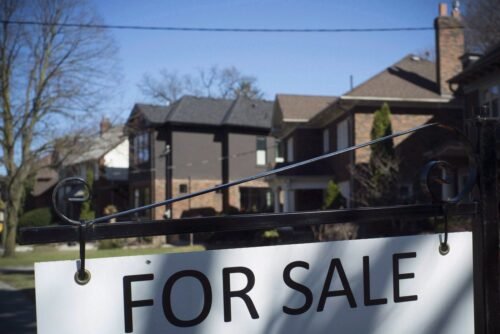
Despite lagging real estate activity in the Greater Toronto Area this fall, improved certainty around borrowing costs and a change in the political dynamic south of the border have spurred hope that buyer sentiment could be set to turn, one broker says.
By Sammy Hudes
Home sales in the region were down in October compared with a year ago as the city’s real estate board said Wednesday that recent doubts around inflation, borrowing costs and the economy kept many potential buyers on the sidelines.
The Toronto Regional Real Estate Board said 5,603 homes changed hands last month, down 7.9% year-over-year, however sales rose 1.2% from September on a seasonally adjusted basis.
The average selling price was $1,024,108, down 2.7% year-over-year, while the composite benchmark price, meant to represent the typical home, was down 4.3%.
“If a Canada-U.S. trade deal is reached, GTA residents could gain a clearer picture of the economic outlook,” TRREB president Daniel Steinfeld in a news release.
“Combined with a resolution to the conflict in the Middle East, this could help ease concerns about inflation and economic uncertainty, strengthen consumer confidence and renew interest in home ownership as we move into 2027.”
While those factors remain unsteady, buyers considering a move could find motivation from developments over the past week both in Canada and the United States, said Davelle Morrison, a broker with Bosley Real Estate Ltd.
After much speculation, the Bank of Canada raised its benchmark interest rate for the first time in more than three years last week. The quarter-point hike means the central bank’s policy rate, which influences the cost of borrowing for banks, businesses and consumers, now stands at 2.5%.
While that will lead to higher rates on key loans like mortgages, Morrison said some buyers might see it as an opportunity to put in an offer before borrowing costs potentially climb even higher.
“Ultimately, I think if there are buyers out there who are thinking of buying, they should meet with their mortgage broker or bank now, go through the mortgage approval process and get some kind of a rate hold … so that way if rates do go up next year, then they’re protected,” she said.
The bank spent much of 2026 watching to see if higher global energy prices from war in the Middle East would spread to other parts of the consumer basket. Inflation ticked up to 3.1% in September, largely due to high gas prices.
The central bank’s rate hike prompted Canada’s major banks to raise their prime rates from 4.45% to 4.70%. But Morrison said that usually translates to an increase of less than $100 for monthly mortgage payments, which shouldn’t scare off the majority of potential buyers on its own.
“So yes, rates increased, but they didn’t increase by a detrimental amount,” she said.
Meanwhile, those wary of making a home purchase while tensions between Canada and the United States continue to simmer might feel some relief Wednesday morning. Morrison described a sluggish fall market for real estate activity, in part because buyer sentiment has felt the chill of tariffs and uncertainty for jobs.
But she said some might be encouraged by results of the U.S. midterm elections, which saw the Democrats gain control of both houses of Congress.
“Maybe they feel that it’s going to improve the tariff situation and things won’t be so gloomy,” Morrison said.
“So now it’s a question of, ‘OK, does that put you in a better head space where you feel like now you’re willing to commit to purchasing a property?’”
There were 14,173 new listings on the market in October, down 11.9% from last year. Active listings fell 10% from October 2025, as total inventory across the GTA stood at 25,098 homes for sale.
Within the City of Toronto, TRREB said there were 2,184 sales last month, down 6.3% from October 2025. Across the rest of the GTA, home sales decreased 8.9% to 3,419.
All housing types saw lower sales year-over-year, led by an 11% decline in townhouse sales, followed by a 10.4% decrease in condo sales.
There were 8.1% fewer semi-detached houses sold last month compared with a year ago, while the detached market saw a 4.4% drop.
“GTA homebuyers continued to benefit from substantial negotiating power on price over the past year,” said TRREB chief information officer Jason Mercer.
“While borrowing costs have increased on the back of higher inflation, the impact on monthly mortgage payments has been mitigated by lower selling prices, helping keep affordability in check.”

Visited 125 times, 125 visit(s) today
Daniel Steinfeld Dashboard home prices The Canadian Press toronto toronto home sales toronto house prices Toronto housing market toronto real estate market toronto regional real estate board TRREB
Last modified: November 4, 2026