


Photo by lifeforstock on Magnific
One thing Canadian investors will eventually notice after exploring the domestic exchange-traded fund (ETF) market is that certain ETF tickers come with a suffix. In a previous article, we looked at U.S.-dollar-denominated ETFs, such as the BMO S&P 500 Index ETF (ZSP.U). These funds provide the same underlying investment exposure as their Canadian-dollar counterparts, with the main difference being the currency in which their units trade.
Similarly, some currency-hedged ETFs have their own suffixes. One example from the same provider is the BMO Long-Term U.S. Treasury Bond Index ETF (Hedged Units) (ZTL.F). It provides exposure to the same underlying bond portfolio as the unhedged version, but uses currency derivatives to mitigate fluctuations between the Canadian and U.S. dollars.
There’s a third suffix worth knowing about, though. And once again, we can turn to BMO for an example: the BMO Ultra Short-Term Bond ETF (ZST.L). The “.L” suffix identifies accumulating units, which fundamentally change how an ETF handles the income generated by its underlying investments.
Accumulating ETFs aren’t unique to Canada. They’re also widely available in Europe, where many ETF providers offer accumulating share classes under the Undertakings for Collective Investment in Transferable Securities (UCITS) regulatory framework. That said, these products remain a relatively small segment of the Canadian ETF market. According to Cboe Canada’s ETF Market Screener, just 93 ETFs are currently classified as accumulating.
Given their relatively limited presence, it’s understandable that many Canadian investors may be unfamiliar with accumulating ETFs or how they differ from conventional distributing funds. So, let’s examine how they work, the practical differences for investors, and, most importantly, how their mechanics affect taxation.
How do accumulating ETFs work?
In Canada, one of the easiest ways to understand the difference is to compare ZST.L with its distributing counterpart ZST. Both hold a diversified portfolio of short-term, investment-grade bonds, generally targeting maturities of one year or less. Their objective is capital preservation and current income, with management expense ratios (MERs) of 0.17% for ZST and 0.16% for ZST.L.
The main difference is how they handle the income generated by their underlying holdings. Most conventional ETFs distribute income to investors periodically, whether monthly, quarterly, semi-annually, or annually. Depending on the ETF’s holdings and structure, those distributions can consist of Canadian eligible dividends, foreign dividends, ordinary income, realized capital gains, or return of capital.
ZST follows this conventional approach, currently offering a 2.59% annualized distribution yield. Investors receive cash monthly in their brokerage accounts, which they can withdraw, spend, or reinvest.
ZST.L works differently. Instead of paying regular cash distributions, it retains and reinvests the income generated within the fund. That income is reflected in the ETF’s net asset value (NAV), allowing investors to compound returns without having to purchase additional units themselves.
However, accumulating ETFs don’t necessarily generate higher returns than their distributing counterparts. Before accounting for taxes and trading costs, two otherwise identical portfolios should deliver approximately the same total return. BMO’s historical performance figures illustrate this.
Over the trailing five-year period, ZST delivered an annualized total return of 3.34%, assuming every distribution was reinvested perfectly. ZST.L reported the same annualized return of 3.34%. The difference is what investors would have needed to do to achieve those results.
With ZST, cash would have arrived in your brokerage account every month. To replicate the reported total return, you would have needed to reinvest those distributions by purchasing additional units. Depending on your brokerage, that could involve placing manual trades, paying commissions, or leaving small amounts of cash uninvested if fractional ETF purchases weren’t available.
With ZST.L, the reinvestment happens within the ETF. You continue holding the same number of units while the retained income contributes compounding to the NAV, completely eliminating the need to reinvest monthly cash payments. You can see this distinction in the price chart below.
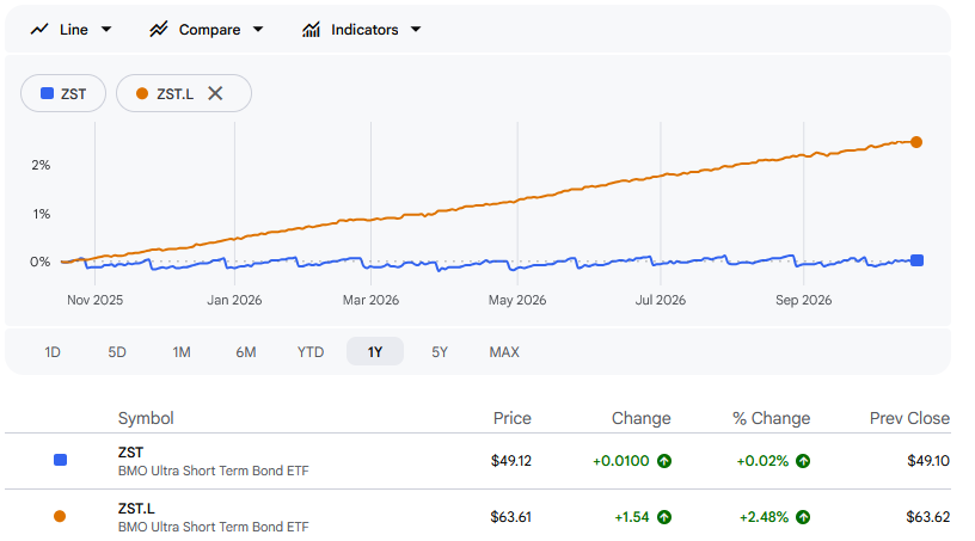
Source: Google Finance
ZST’s market price reflects the periodic reductions associated with its cash distributions, so looking at price appreciation alone understates its total return. ZST.L, by contrast, retains that income within the fund, allowing its NAV and, generally, its market price to reflect the accumulated returns more directly.
That’s the main appeal of accumulating ETFs: they simplify the reinvestment process while providing essentially the same underlying investment exposure. However, as we’ll explore next, retaining income within the fund doesn’t necessarily mean investors can avoid paying taxes on it.
You still have to pay taxes with accumulating ETFs
A common misconception among newer Canadian investors is that accumulating ETFs offer a way to avoid taxes by retaining income rather than distributing it. Unfortunately, that’s not how it works. The easiest way to understand this is to examine the historical distributions of ZST and ZST.L. Throughout 2025, ZST paid a cash distribution every month. Most of these distributions were classified as ordinary income for tax purposes, with smaller amounts attributable to capital gains and return of capital.
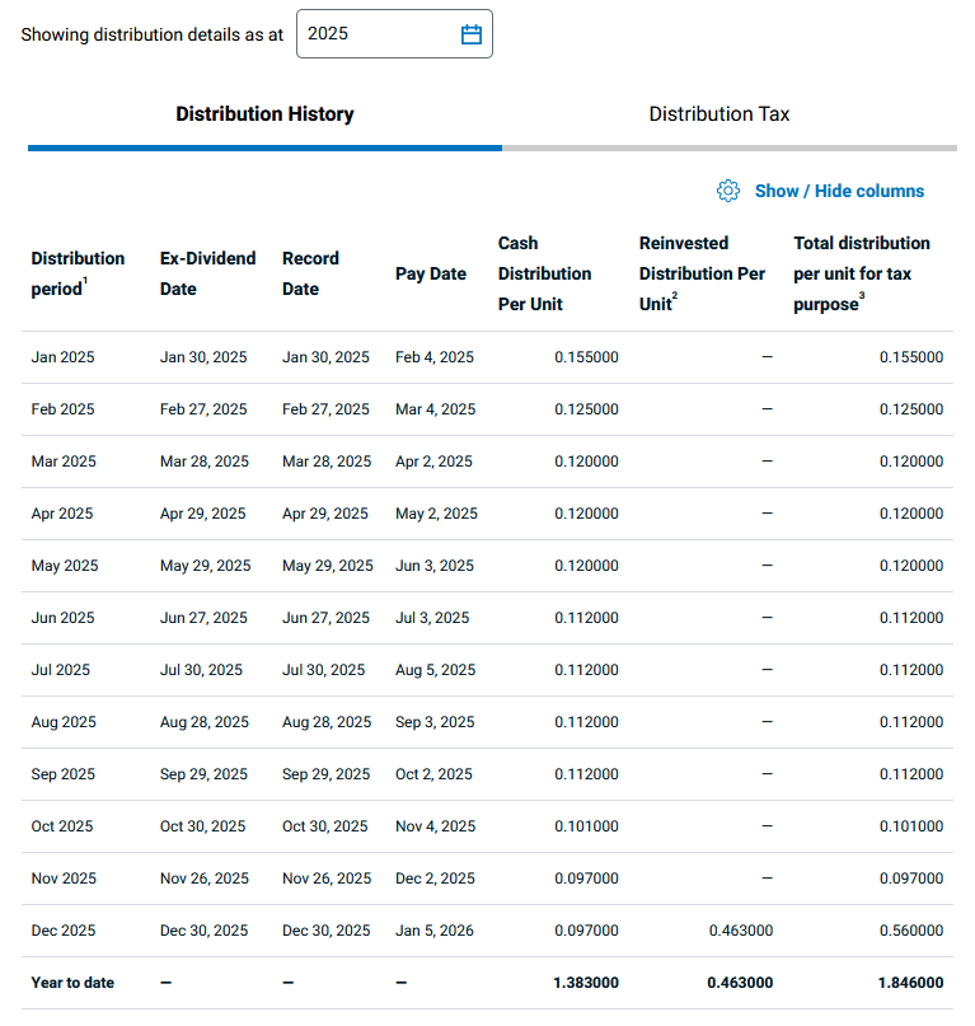
Source: BMO Global Asset Management
ZST.L, meanwhile, made no cash distributions to investors. However, in March, June, September, and December, it reported what BMO calls a reinvested distribution per unit. A footnote indicates that non-cash distributions must be accounted for by investors for tax purposes.
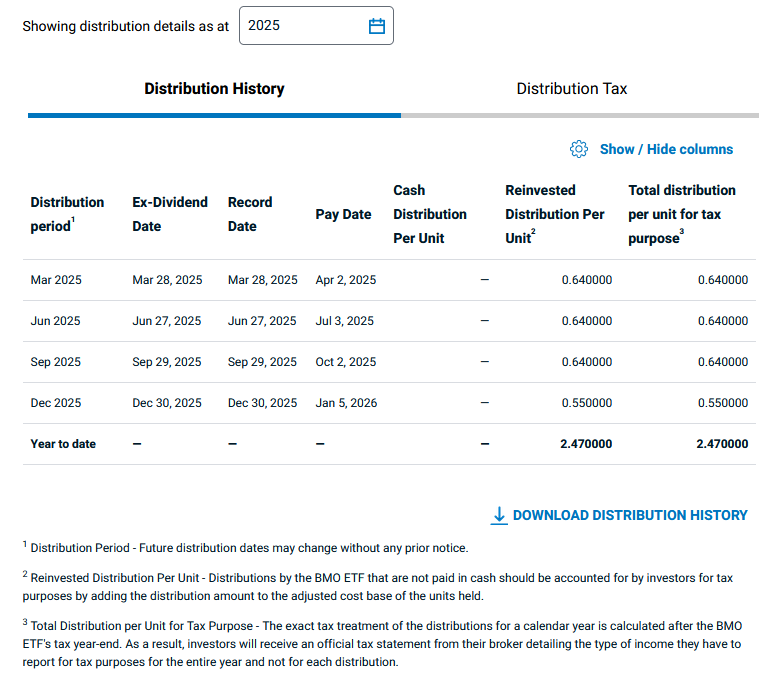
Source: BMO Global Asset Management
Specifically, reinvested taxable distributions increase your adjusted cost base (ACB), reflecting income that has already been attributed to you for tax purposes. Increasing your ACB helps prevent that same amount from being taxed again as a capital gain when you eventually sell your ETF units.
The practical implication is that accumulating ETFs aren’t inherently more tax-efficient than comparable distributing ETFs in a non-registered account. Their primary advantage is reducing the operational complexity of reinvesting distributions. Just because you don’t receive cash in your brokerage account doesn’t mean a distribution hasn’t occurred for tax purposes.
The ETF manager handles the reinvestment internally, but the resulting taxable income and capital gains are still attributed to investors and must be reported accordingly. In a non-registered account, you’ll therefore still need to review your tax slips and maintain accurate ACB tracking.
Why use an accumulating ETF?
Accumulating ETFs can make sense for investors prioritizing long-term capital appreciation over current income. If you’re investing for the future rather than withdrawing cash from your portfolio, having distributions automatically reinvested within the fund can simplify the process.
Consider ZST versus ZST.L. If you value the capital preservation potential of a high-quality, short-term bond ETF but don’t need its monthly income, ZST.L may be the more convenient choice.
After all, if you were planning to reinvest every distribution from ZST anyway, why not have the ETF manager handle it for you? Doing so internally can be more efficient than manually placing buy orders, potentially paying brokerage commissions, and dealing with fractional units or small amounts of residual cash that can’t immediately be reinvested.
In a non-registered account, however, there’s also a reasonable case for sticking with the distributing version. Since accumulating ETFs don’t eliminate tax liability, you might prefer to receive the cash directly and decide whether to reinvest, withdraw, or use it to cover your tax bill.
There is one important distinction worth mentioning, though. Certain Canadian ETFs pursue a no-distribution policy while offering potential tax advantages. The most notable examples are Global X Canada’s corporate-class, swap-based ETFs.
However, these aren’t accumulating ETFs in the conventional sense. Their corporate class structure, use of total return swaps, associated costs, and counterparty risks make their mechanics fundamentally different. They deserve a separate discussion rather than being grouped with straightforward accumulating ETFs such as ZST.L.
For most Canadian investors, the decision between accumulating and distributing units therefore comes down to how they intend to use their portfolio. If you’re reinvesting or planning to use a dividend reinvestment plan (DRIP), accumulating units can remove a few administrative steps. If you value cash flow and flexibility, conventional distributing ETFs remain perfectly reasonable.
Read more about investing with ETFs:
- How to buy ETFs
- Should Canadian investors break up with their bond ETFs?
- Buying ETFs in Canada Tool: The MoneySense ETF Screener
- Best ETFs in Canada for 2026

About Tony Dong, MSc, CETF
Tony Dong has been published on USA Today, U.S. News & World Report, TheStreet and more. He is also the lead ETF analyst for ETF Central, and he holds The ETF Institute’s Certified ETF Advisor designation.
Related Articles

Ontario Trillium Benefit notice: What does it mean?
Have you received an Ontario Trillium Benefit (OTB) notice from CRA? Here is what it means and what you…

Should Canadian investors break up with their bond ETFs?
Since the 2022 bond bloodbath, investors have questioned bond ETFs. Learn how stock-bond correlations, diversification benefits and alternative ETF…

How can I leave more money to my children?
The oft-cited RRIF meltdown tactic is a distraction. Concentrate instead on leaving a bigger legacy—or giving it away right…

Why young Canadians are staying in (and what it’s really about)
From dinner parties to movie nights, staying in is on the rise. Explore why young Canadians are embracing the…
Why young Canadians are staying in (and what it’s really about)
The calming genius of passive investing
David Booth’s Stay Calm lays out the latest, highly convincing case for sticking to indexing and doing less as an investor.

Bitcoin price comes roaring back, up over 40% in three months
We’re looking at how Bitcoin and various other cryptocurrencies have fared in the second half of 2026.
Bitcoin price comes roaring back, up over 40% in three months

Most Canadians don’t know how much they spend on housing. Do you?
Credit Canada found that 68% of Canadians don’t know how much of their budget goes toward housing. Those who…
Most Canadians don’t know how much they spend on housing. Do you?

How a spousal RRSP can save couples tax
There are still unique advantages to spousal RRSP accounts, even after the advent of pension splitting.

What are the best Canadian ETFs for the Smith Manoeuvre?
Yes, you can execute this combination of mortgage repayment and investing using ETFs. Your options depend on risk and…

Veterans Affairs Canada to send out payments on Monday
Some Canadians will receive a payment from Veterans Affairs Canada (VAC) on Monday, September 28, 2026. The governmental department…