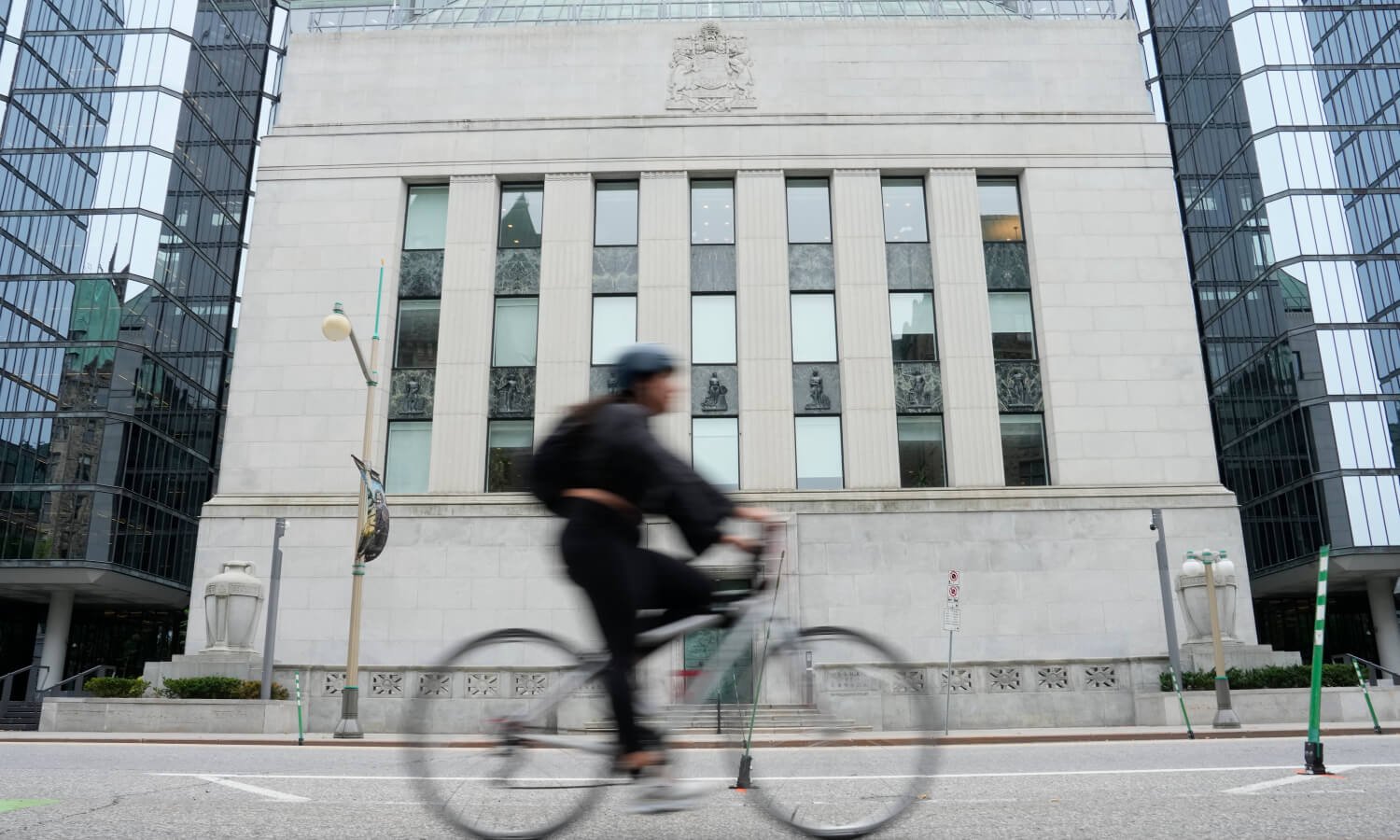
Bank of Canada Governor Tiff Macklem said Prime Minister Mark Carney’s fiscal plans aren’t yet making it harder for the central bank to control inflation.
By Mario Baker Ramirez and Erik Hertzberg
(Bloomberg) — Bank of Canada Governor Tiff Macklem said Prime Minister Mark Carney’s fiscal plans aren’t yet making it harder for the central bank to control inflation.
Speaking to lawmakers Tuesday, Macklem said he would comment on fiscal policy in two situations: if government finances became unsustainable and spilled over into markets, or if fiscal and monetary policy were working at cross purposes and making it harder to return inflation to the Bank’s 2% target.
“In the current circumstances, I don’t think either of those criteria are met,” Macklem told the House of Commons finance committee.
Macklem said the government’s existing spending plans aren’t materially adding to inflation pressures, pointing to excess capacity in the economy and the government’s emphasis on investment rather than operating spending.
Last week, the central bank hiked the policy rate to 2.5% to keep higher oil prices from spreading more broadly into inflationary pressures.
The comments come as the federal government prepares to unveil its budget on Thursday. Carney has already announced the so-called productivity mega deduction, which is expected to cost $36 billion over five years and broaden immediate tax write-offs for business investment. The budget’s overall fiscal shortfall is expected to be about 2% of the size of the economy.
In prepared remarks to the committee, Macklem said growth should pick up in 2027 as exports and investment strengthen, “supported by fiscal measures.” Last week, he suggested the bank’s estimates for investment were “conservative,” though they were one of the largest upside revisions in its forecast relative to July.
Speaking to lawmakers, Macklem also noted the importance of fiscal spending composition.
“Are they spending it on things that are just going to boost the economy in the short term, or are they investing for the future and building the capacity of the economy to grow?” he asked.
Macklem has previously criticized provincial and federal governments for focusing too heavily on priming demand and consumption, and less on expanding the productive capacity of the economy.
Not everyone agrees that fiscal and monetary policy are pulling in the same direction.
Doug Porter, chief economist at the Bank of Montreal, said the broad fiscal support being provided by federal and provincial governments is at odds with the Bank of Canada’s decision to hike borrowing costs last week.
“Fiscal policy is geared to providing important support to the economy through this difficult period of trade uncertainty,” Porter said.
“I believe that monetary and fiscal policy are working at cross purposes,” Porter said, adding that his view could change if Canada and the U.S. reach an agreement that reduces trade uncertainty and tariffs.
The bank’s hike last week was the first in more than three years. Macklem told the committee Tuesday there could be a need to raise rates further, but said policymakers will proceed carefully amid elevated uncertainty.
©2026 Bloomberg L.P.
Visited 1 times, 1 visit(s) today
Bank of Canada bloomberg BoC Dashboard douglas porter inflation Parliament’s Standing Committee on Finance testimony tiff macklem
Last modified: November 3, 2026